An article by Scott Williams
published on 31 Aug 2023
Ops people can be creative too.
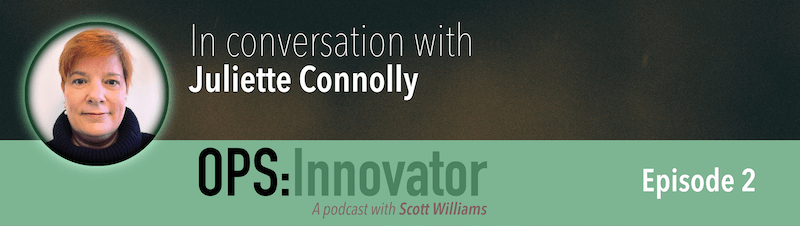
In this OPS:Innovator podcast episode, I spoke with Juliette Connolly about creating great experiences. Naturally, the conversation focused mainly on employee experience because you’re unlikely to achieve any other without first striving for an excellent EX.
Here’s the tl;dr:
- There is as much opportunity for creativity in operational roles as any other
- To drive engagement in innovation activities, set some boundaries around a field of play
- One of the most essential investments organisations can make is in leadership
- To make a real impact, allow people to focus on their strengths more than their weaknesses
Jules kicked us off by talking about how it’s the operational people inside of organisations who truly see and understand the foundations of an organisation. If something isn’t working right, or the operational bricks in that foundation are misaligned, the whole thing will eventually come crashing down. It requires creativity and a deep understanding on the part of us ops folks to make that a meaningful thing for a business. Can I get an amen!?
But, some of our operations colleagues like their structure and knowing where the boundaries are. There’s nothing wrong with that. In fact, Jules suggests that it might be a good thing when looking to encourage people to engage in looking for innovative areas in which to play. Why? Because it creates a space where it’s OK to try new things and have them not work (sometimes called “failing”, and boy, did we dig into that one).
Once you have that safe space to play where those who might be naturally risk-averse are comfortable giving innovation a go, you can start realising the kinds of human outcomes we can get from thoughtful and creative operational innovation efforts.

If the result isn’t ultimately a better experience for a human, did you really innovate? I suppose technically, the answer could be yes, but should it? If you don’t at least consider the experience, any innovative solution you come up with will not be as widely celebrated – or accepted – as you would like. No one is saying it has to be perfect on day one. But whatever day one looks like, there will always be some sort of human experience accompanying it, so don’t forget to think about what it should be.
When we try innovative things, each of us will eventually have the “uh oh, I screwed up and now feel very vulnerable” moment. I’ve had my share, and they aren’t fun at all. What’s supported me through them is solid leadership, so in our list of investment priorities, that capability must be included pretty high in the list. Investing in adaptive and empathetic leadership and making leaders accountable for employee engagement will significantly raise the bar.
All of this brings us to another game piece organisations can play to help drive operational innovation: letting people leverage and focus on their strengths. Jules says that one of the best things she has ever experienced as a leader is the ability to look at her organisation’s strengths holistically to better organise and enable teams so they can lean into what they’re best at. That’s their superpower.
To hear more of this conversation or those with any of our other notable guests, check out OPS:Innovator wherever you get your podcasts or find all our shows on YouTube.
For more engaging content on operational innovation and transformation, join the conversation at tenpercentlabs.com.
Copyright 2023 Ten Percent Labs. All Rights Reserved.
 Ten Percent Labs